“The Blue Fund” and the African Development Bank
In Brazzaville, $3 Billion Raised for the Congo Basin Blue Fund!
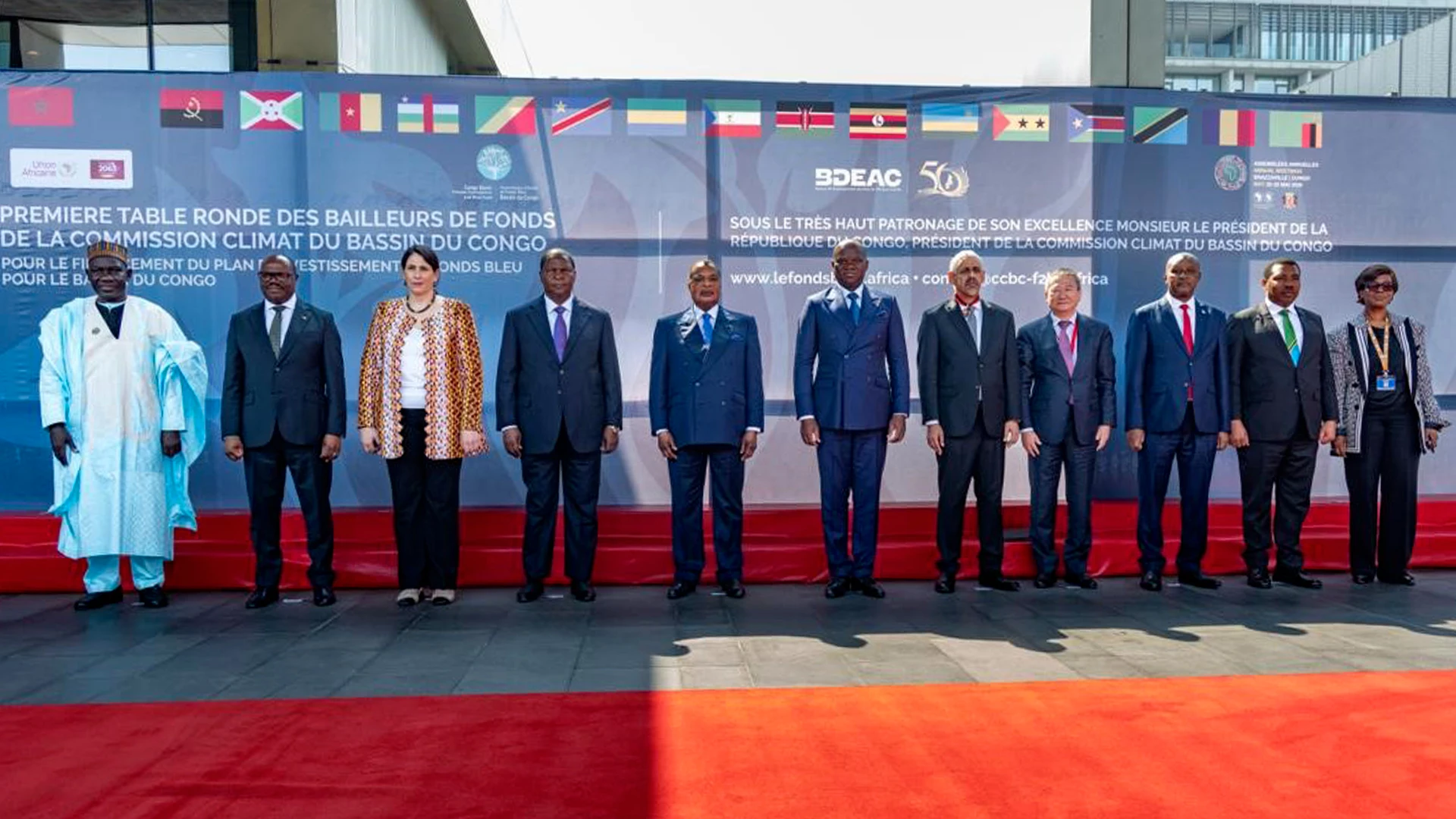
On the sidelines of the 61st Annual Meetings of the African Development Bank (AfDB), Brazzaville hosted a donor roundtable on Tuesday, May 26, aimed at financing the Congo Basin Blue Fund’s priority program. Created in 2016, this mechanism aims to support projects related to the conservation of natural resources in the countries of the subregion.
A total of 63 projects have been identified as priorities in the water, energy, agriculture, and climate change sectors, benefiting 17 countries in Central and East Africa. The funding sought amounts to $5.3 billion by 2028.
President Denis Sassou Nguesso, who led the proceedings in the presence of his Central African and Gabonese counterparts, welcomed this first step: “The longest journey begins with a single step, and we have just taken it. Roughly speaking, I can announce that $3 billion has been pledged, along with 7 trillion in guarantee funds. So we have reason to celebrate.”
Among the institutions involved are the African Development Bank, the Development Bank of Central African States (BDEAC)—the Blue Fund’s trustee—and the African Solidarity Fund (FSA). Gabonese President Brice Clotaire Oligui Nguema, for his part, emphasized the role of the Congo Basin in the fight against climate change. “The Congo Basin must no longer be viewed as an ecological periphery; it must be recognized as a strategic hub for global climate stability. The Congo Basin is a strategic asset for Africa,” he stated. The selected projects are to be implemented between 2026 and 2028.
This financial mobilization comes as the African Development Bank expresses a degree of optimism regarding the continent’s economic outlook. During its annual meetings, the institution released its report “African Economic Outlook 2026.” In it, the AfDB forecasts average growth of 4.2% for the continent in 2026, following 4.4% in 2025. Twenty-two African countries could even exceed 5% growth.
According to the AfDB, this momentum is driven in particular by strong agricultural performance, high commodity prices, and several structural reforms underway across the continent.
However, significant regional disparities remain. East Africa leads the way with an expected 5.9% in 2026, ahead of West Africa at 4.7%. Central Africa is projected to grow by 3.8%, supported by oil revenues, while Southern Africa is expected to lag behind with estimated growth of 2.1%, held back by declining mining output and rising energy costs.
The AfDB also warns of persistently high inflation, estimated at 10.4% for the continent as a whole, and calls on African governments to strengthen domestic resource mobilization as well as public-private partnerships.